Choosing what to keep human: a four-question filter
You made a list of everything you could hand off, and it came to nearly everything. That is a warning sign, not a plan. Some of that work is the reason you are in the role at all: the call you make when two people disagree, the sentence that says sorry, the decision nobody else can sign. (A hypothetical scene, for illustration.)
Handing work off well starts with deciding what stays with you. A four-question filter takes about five minutes per task and works for any helper, whether a colleague, a contractor or an AI assistant. Ask the questions in order and note every yes:
- Would a mistake here be hard to undo? Sending, paying, publishing, deleting and signing are all hard to take back. A task that ends in one of them can still be prepared by a helper, but the last step stays with you.
- Does it carry your name in a way that matters to the reader? A thank-you, an apology, a difficult message or a reference. People can tell when a message was routine and when it was meant. Keep these, or at least write the first line yourself.
- Does it rest on judgment you cannot yet explain? If you cannot say how you decide, you cannot brief it. Do the next few yourself and write down what you notice, and the brief will start to write itself.
- Is it work you want to stay close to? Some tasks keep you in touch with what is going on: reading the first replies to an announcement, sitting in on a call. Keep a thin slice of those even when a helper could do all of it.
If every answer is no, the task is a good candidate to hand over whole. If any answer is yes, split it: hand over the preparation and keep the part that triggered the yes.
A task can land in three places: hand over, keep or split. Most land in the third. Gathering the figures, drafting the reply and tidying the list are handoffs. Deciding, sending and signing are yours.
Say the split in the brief. "Prepare the draft and stop. I will read it and send it myself" is a complete instruction, and it keeps the last step exactly where you want it.
Review the filter every few months. Something you kept because you did not trust the process may have earned a handoff, and something you handed over in a hurry may need to come back. Neither is a failure. It is the filter doing its work.
A hypothetical Monday list: sorting the inbox goes to a helper, with a written list of rules. Drafting replies to routine requests goes to a helper, and you send them. Replying to a colleague who is upset stays with you. Pulling together the weekly figures goes to a helper. Choosing which supplier to renew is split: the helper compares the options in a table, and you decide.
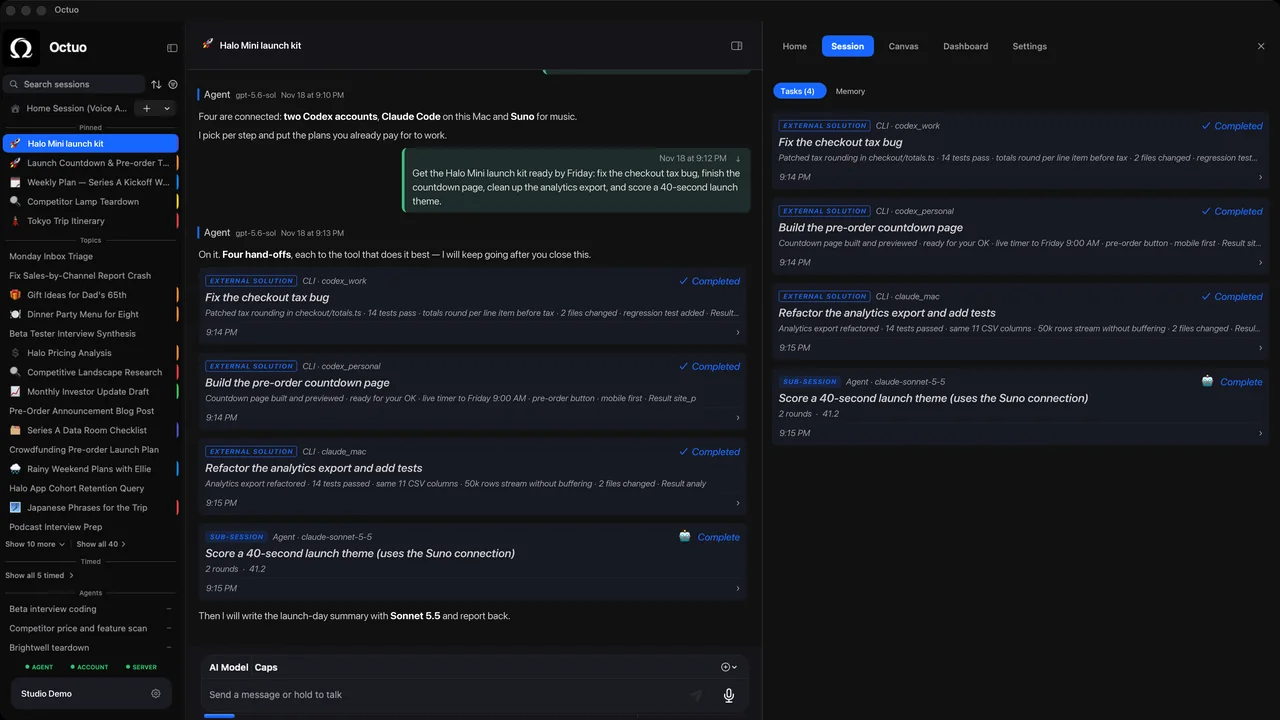
Octuo is a personal assistant and one starting point for work across AI, tools and specialist services. It hands tasks to specialist tools you've installed, set up and authorized and to outside services, you grant the permissions, and it reports back when a job is done. Deciding what to hand to any of them, and what to keep, is the first brief to write. Octuo is available for macOS.