Skills, MCP, subagents or hooks: which one?
Choose by the job. A skill teaches the agent a repeatable workflow. MCP connects it to a tool or data source outside your project. A subagent takes a side task into its own clean context. A hook runs your script at a lifecycle event, every time, without the agent deciding. Start with just one.
What does each one actually do?
- Skill. A
SKILL.mdfile of instructions the agent reads when a task fits. Both tools keep only the name and description in view until a skill is used. - MCP. The Model Context Protocol is an open standard for connecting an agent to outside tools and services, such as an issue tracker or a database.
- Subagent. A separate worker with its own context window. It does the noisy work and returns a summary.
- Hook. Your own script, run when a lifecycle event fires. Claude Code's docs call this deterministic: it happens because the event happened, not because the model chose to. Codex requires non-managed hooks to be reviewed and trusted before they run.
Under all four sits the always-on instruction file (CLAUDE.md for Claude Code, AGENTS.md for Codex); both vendors suggest starting there.
Which one fits my problem?
Claude Code's docs tie each feature to a trigger:
- You keep pasting the same checklist or procedure: write a skill.
- You keep copying data from a tool the agent cannot see: connect it through MCP. Check that you trust the server first; our seven questions for a new tool help.
- A side task floods the conversation with output you will not need again: use a subagent.
- You want something to happen every time without asking: write a hook.
Codex's docs give a similar order: AGENTS.md, skills, MCP for outside systems, then subagents for noisy or specialized tasks.
In Claude Code's words, an instruction in CLAUDE.md or a skill is "a request, not a guarantee". If a rule must hold every time, make it a hook.
How do they work together?
They combine. Claude Code's docs pair a skill with MCP: MCP provides the connection, and the skill teaches the agent how to use it well. Codex's docs call its layers "complementary, not competing".
Two cautions. Subagents are not a shortcut for usage: Claude Code's docs say a subagent's requests count toward the same usage limits, and Codex's say subagent workflows consume more tokens than a single agent. And Codex's docs say parallel agents suit read-heavy work such as exploration and tests; be more careful when several agents write code at once.
For running both tools side by side, see using Claude Code and Codex together. For something that coordinates several agents above these settings, see what an AI agent orchestrator is.
Where Octuo fits
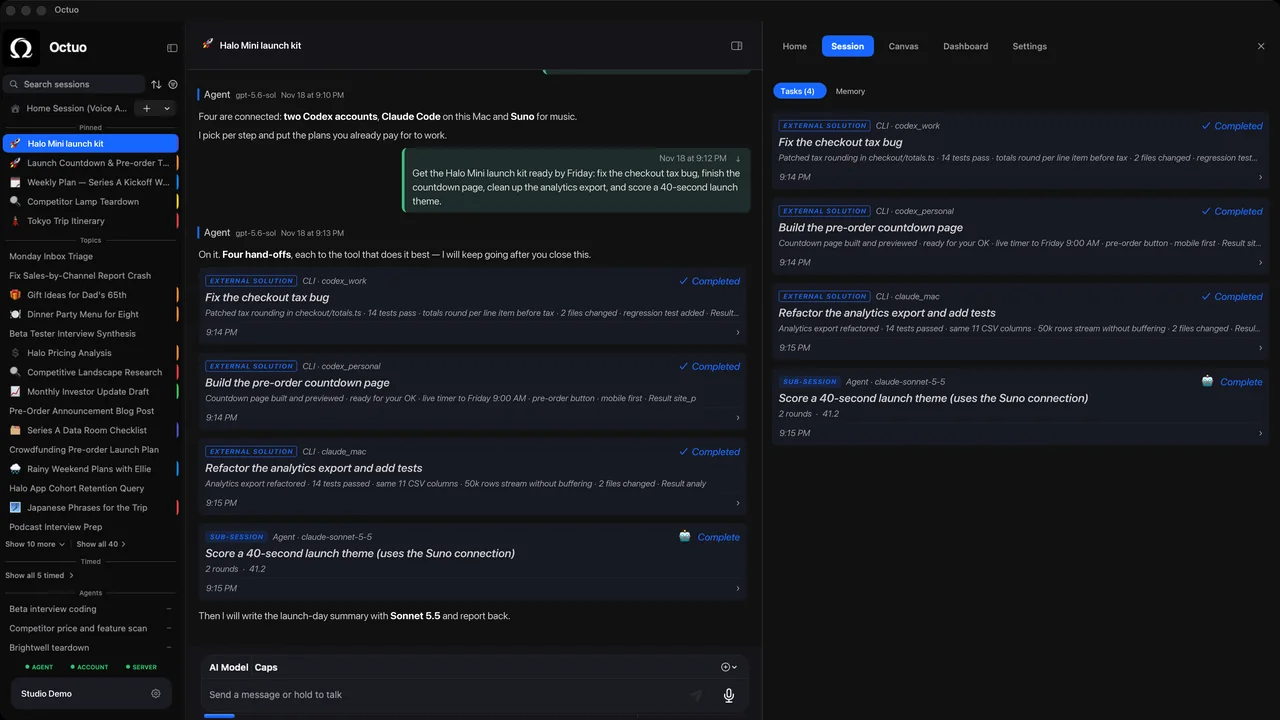
These four are settings inside one coding agent; Octuo works a level above. Octuo is a personal assistant that coordinates your AI tools, agents and outside services for you: you say the goal, and it handles the preparation, delegation and follow-up.
Octuo has skills, sub-agents, scheduled routines and integrations that both you and Octuo can add and modify, and it can hand work to MCP tools. Give Octuo a goal. It delegates work to supported tools and agents, carries the context they need and brings the results back. That means supported tools, not every tool already integrated.
Octuo can install and configure supported CLIs and handle the setup steps it is authorized to perform. You step in for your own account sign-ins, payments and sensitive approvals that must be yours; Octuo handles the surrounding work.
Octuo is a native Mac app and needs an internet connection. See what Octuo does.
FAQ
Do I need all four? No. Start with the instruction file and add one feature when an annoyance repeats.
What is the difference between a skill and a hook? A skill is instructions the agent reads and applies, so the outcome can vary. A hook fires on its event without the agent deciding.
Do subagents save usage? Not necessarily. They protect your main conversation from noise, but each does its own model and tool work, so several subagents can use more than one agent would.
Sources
- Claude Code docs, "Extend Claude Code": https://code.claude.com/docs/en/features-overview
- Claude Code docs, "Extend Claude with skills": https://code.claude.com/docs/en/skills
- Claude Code docs, "Create custom subagents": https://code.claude.com/docs/en/sub-agents
- Claude Code docs, "Connect Claude Code to tools via MCP": https://code.claude.com/docs/en/mcp
- Claude Code docs, "Automate actions with hooks": https://code.claude.com/docs/en/hooks-guide
- Codex docs, "Customization": https://learn.chatgpt.com/docs/customization/overview
- Codex docs, "Subagents": https://learn.chatgpt.com/docs/agent-configuration/subagents
- Codex docs, "Hooks": https://learn.chatgpt.com/docs/hooks
The product names above belong to their owners. We have no affiliation with them.