Game jam, team of one: one brief, four handoffs
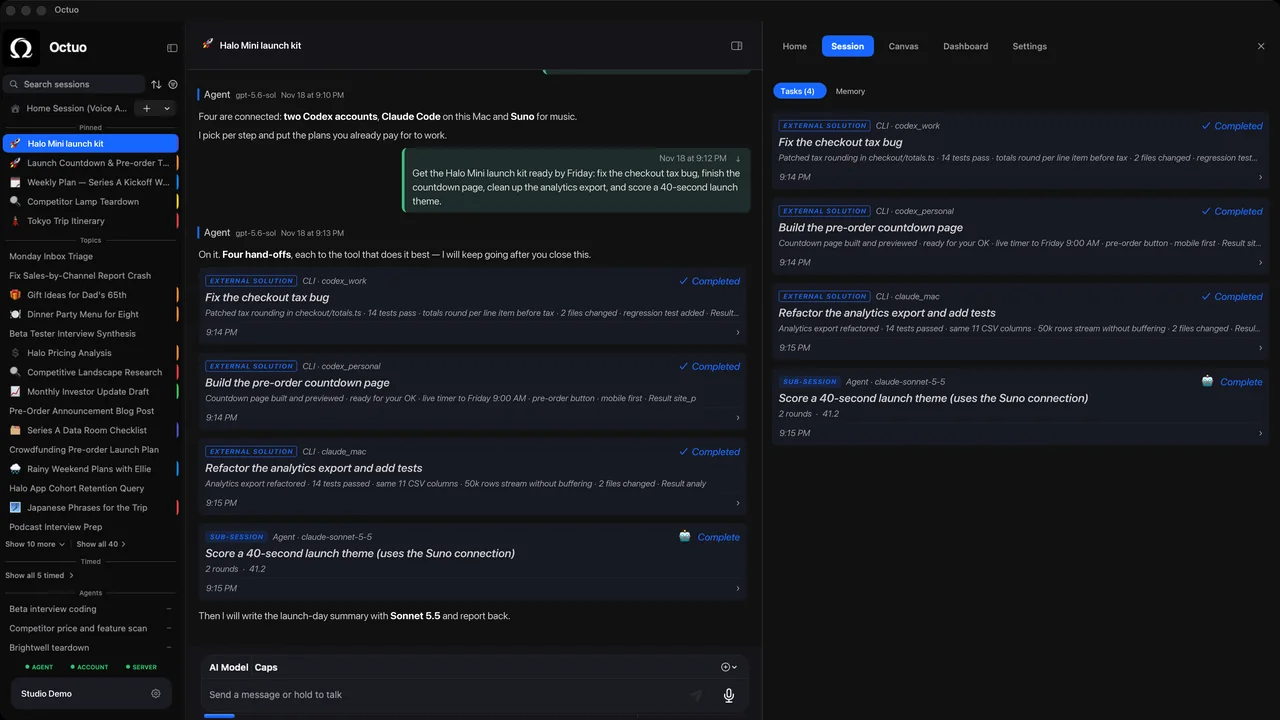
It is Friday night of a game jam, you are the entire team, and you have a bug that breaks the build, no icon and no music. You write one brief and hand it to Octuo. It splits the work across the tools you have connected, follows each run and sends back one report instead of four loose threads.
What Octuo does at that moment
- You say the goal once: fix this bug, make an icon, make a music loop, and here is the game and its theme.
- Octuo delegates the work to supported tools and agents. Here that means two of your own Codex accounts, an image tool and a music service, with the context each one needs carried along.
- Octuo follows the work and reports back. Progress is there whenever you want to check, and decisions that need you come to Attention.
- The results come back into the same conversation, gathered into one report.
- You step in for your own account sign-ins, payments and sensitive approvals that must be yours. Octuo handles the surrounding work.
Three examples
These are illustrative situations, not customer stories.
One brief on Friday night
You type one request: the game's name and theme, the bug, the icon and the music you want. Octuo hands the bug to one Codex account, a second code task to another, the icon to an image tool and the music to a music service, all at the same time. That is four handoffs from one brief, and you can keep playtesting while they run. If your brief holds several asks, numbering them makes each one easier to track.
Two code tasks, two accounts
You hold two Codex accounts of your own and have signed in to both yourself. The bug goes to one and a second code job, say the title screen, goes to the other, so neither task waits behind the other. Octuo brings the project background to both, so you do not paste it twice. Whether a split like this pays off for a given job is a fair question, and we look at it in when is it worth running several AI agents on one job.
One report, one decision for you
Near the end, Octuo sends one report listing what each handoff returned: the fix, the second code change, the icon and the music. The part that needs you, such as whether the icon fits the game, comes to Attention. You review the results, decide what goes into the entry and submit it yourself.
What it does not do
Octuo does not judge the quality of what each tool makes: you review the code, the icon and the music yourself. It also gives you no rights to the generated assets, so read each service's terms before you submit anything to a jam, and it works only with your own accounts and tools once they are connected.
FAQ
Do I need accounts with each of those tools? Yes. Octuo coordinates work through your own authorized accounts under each service's terms, so you sign in to Codex and to any image or music service yourself. Charges from those services stay separate from Octuo. If you want the wider picture, see handing tasks to Claude Code and Codex.
Who checks the results? You do. Octuo gathers the results and flags what needs a decision, but it does not judge quality, and a jam's rules about generated assets are yours to read.
What if one handoff fails? Octuo follows each handoff and gathers what comes back into the report, so you can see which piece is still missing. What happens next is your call: ask again, do it by hand or drop it.
See what Octuo does. Octuo is in public beta on macOS and web, and an iPhone app is coming soon. New accounts get 1,000 OC trial credits, once per person, no card.
The product names above belong to their owners. We have no affiliation with them.