What a “starting point” for AI and tools should actually do
Publicado originalmente em WordPress em 1 de outubro de 2026.
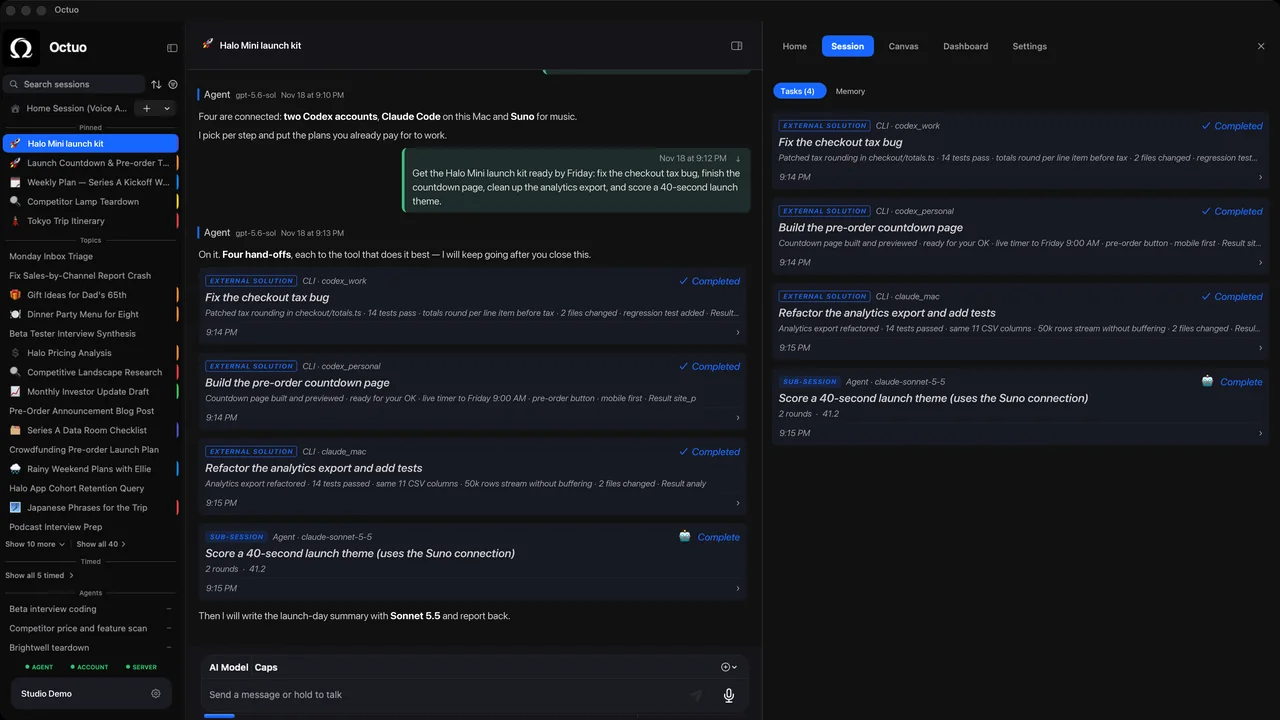
Good AI tools are easy to find. Getting them to work together on one job is the hard part.
Think about the last piece of work that touched more than one tool. Chances are you decided which tool to use, explained the task, moved files, waited, checked the result and carried it back. Each step was small. Together they were the job, and all of it was you.
We’re the Octuo team, and we build a personal assistant around a simple idea: the place you start work should be one place, not a different window for each tool. Here’s what we think a starting point has to do to earn that name.
1. Take the goal, not the instructions.
“Draft a follow-up for every open question in last month’s project notes” is a goal. “Open the notes, copy this, paste that” is a script. A starting point should let you describe the outcome and work out the steps.
2. Bring in the right capability.
Some work is best done by a model, some by a specialist tool already on your computer, some by an outside service. Octuo doesn’t try to do everything itself. It hands tasks to specialist tools, including coding agents such as Codex or Claude Code, and to outside services. Those two are named only as examples of tools it can hand work to.
3. Carry the context.
A handoff fails when the receiving tool doesn’t know why the task exists or what has already been decided. The assistant’s job is to carry what that task needs, so you aren’t retyping it.
4. Keep track.
A long job should have a visible state: running, waiting, done. You shouldn’t have to hover.
5. Bring results back.
Finished work has to land somewhere you will actually see it, with what was done, what was found and what needs your decision.
That is the coordination work we built Octuo to take on. It also keeps going when the chat closes, so you come back to results rather than to where you left off.
Where it stands today
Octuo is available for macOS. It coordinates the supported tools and services you connect and authorize. You grant the permissions; credentials live in an encrypted Secrets Vault the language model never sees; and cost is previewed before and reported after every turn. It’s moving fast, and every release widens what it can reach.
A test you can run without us
Whatever you use, judge it by one question: when you come back, is there a result waiting, or only a chat? If it’s only the chat, there’s still a handoff left for you to do.