Sort your requirements into must, should and nice before you ask for options
2026년 10월 6일에 Blogger에 처음 게시된 글입니다.
You ask for options for a team offsite and get twelve venues. None is wrong. But six are too far away, four are over budget and two have no room for lunch, and you knew all of that without ever saying it. (A hypothetical scene, for illustration.)
Options come back sorted by whatever the helper guessed you cared about. You can steer them by sorting your own requirements first. The method takes ten minutes, works for any helper, and has five steps:
- Write every requirement on its own line, as it occurs to you, with no ranking yet. Include the obvious ones. What is obvious to you is invisible to everyone else.
- Mark each line must, should or nice. A must is a dealbreaker: an option that fails it is out. A should is something you would trade for a good reason. A nice is a tiebreaker and nothing more.
- Put a number or a test on every must. "Close to the office" is a wish. "Under forty minutes by public transport from the main office" is a test an option can pass or fail.
- Keep the musts to a handful. If you have more than five, some of them are really shoulds. A long list of musts returns an empty list of options, which is information, but not the information you were after.
- Ask for options with a pass or fail on each must and a note on each should. A small table does it: options down the side, requirements across the top, a tick or a cross in each cell and one line of comment when an option comes close.
Add one more line to the request: "If no option meets every must, show me the closest two and say which must each one misses." It protects you from an answer that quietly bends a must to produce something.
Two cautions. Be honest about the musts. People often find, when they see the options, that one of them was only a preference. That is fine: change its label and ask again. And if you are choosing a service you will depend on for a while, ask for the source behind each claim so that you can open it yourself.
A hypothetical result for the offsite. Musts: under forty minutes by public transport, room for twenty people, lunch on site and a quiet room for one session. Shoulds: outdoor space and a projector. Nice: a good view. Four of the twelve venues pass all four musts. You compare those four on the shoulds, and the decision takes ten minutes, not an afternoon.
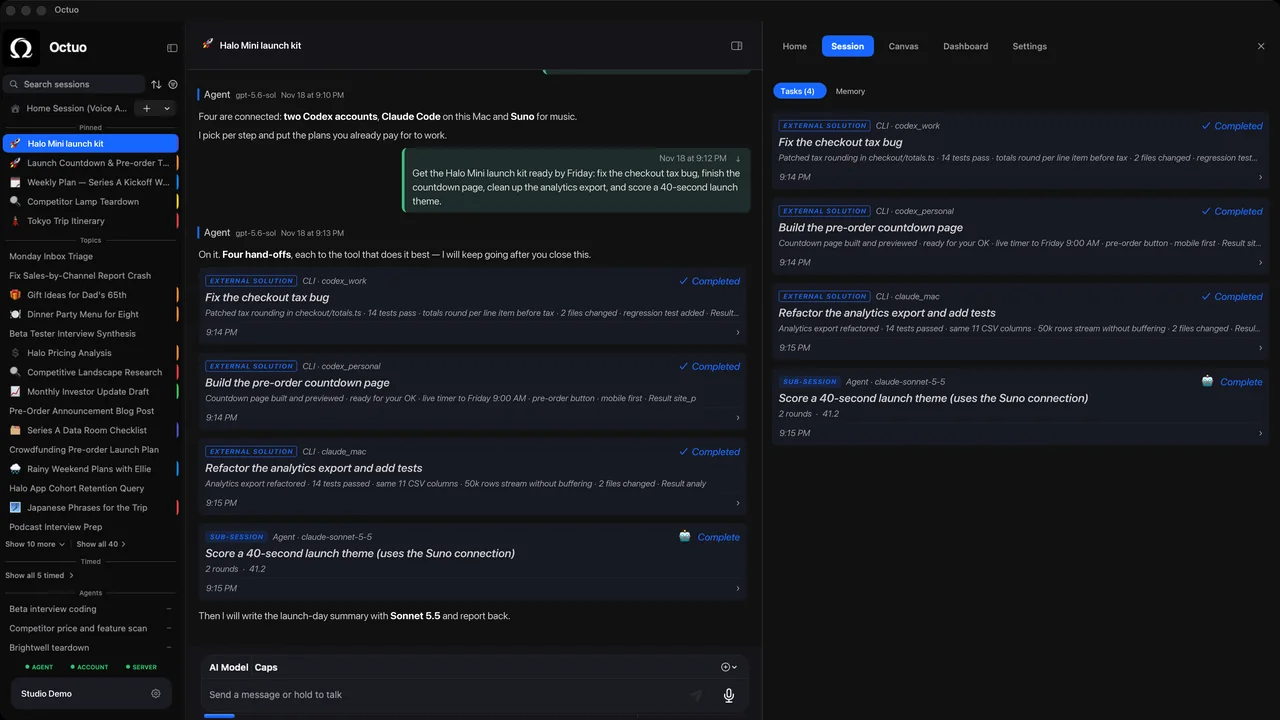
Octuo is a personal assistant and one starting point for work across AI, tools and specialist services. It hands tasks to outside services, it can control the browser and perceive your screen under your control, and it reports back when a job is done. A requirements table is the kind of brief worth handing to any helper. Octuo is available for macOS.