How many results from a big batch do you actually have to read?
初出:Blogger(2026年10月2日)
Say an assistant has just summarized forty meeting notes, or renamed four hundred files, or drafted fifty product descriptions. You can't read everything, and you don't want to trust everything. Somewhere between "read it all" and "looks fine" there is a sensible amount, and it is usually smaller than people fear. (A hypothetical scene, for illustration.)
The idea is to review in layers: look at a little of everything cheaply, then look at a few of the risky ones carefully. This routine works whether the batch came from a person, a script or an AI assistant:
- Skim the whole batch for shape, not content. Are the items about the same length? Do any come back empty, or repeat word for word? Outliers in length and format are often where the first problems show up. Two minutes is enough.
- Pull a handful at random and read them in full. Choose by rule, not by feel: every seventh item, or every item whose number ends in 3. If you choose by eye you will pick the interesting ones, and those are not a fair sample. Five to ten is a sensible start for a batch this size.
- Add the awkward ones on purpose. Read the longest, the shortest, the oldest and the one with the strangest source. Those are the cases your brief was least likely to anticipate.
- Tally what you found and sort it by kind. One slip in ten items is a different situation from three kinds of slip in three items. If one kind of problem shows up twice, assume it is in the rest of the batch too.
- Decide from what you found, not from what you hoped. A clean sample earns a lighter look at the rest. A messy one means fixing the brief and rerunning the batch, not patching items one at a time.
Write down the rule you used and the sample size, so next week's batch gets the same treatment. And raise the sample when the stakes rise. If a mistake would reach a report that gets forwarded to a lot of people, read more of the batch, or all of it.
Here is how the forty meeting notes might go. The skim shows two summaries far shorter than the rest. The seventh-item rule picks five more. Reading the seven, you find that three of them drop the action items. That is one kind of problem showing up three times, so the right move is to add "list every action item" to the brief, rerun the batch and sample again.
One honest limit: sampling finds patterns, not every individual error. If a single wrong item would be costly, such as a wrong amount on a payment, the rule for that kind of item is full review, and sampling is for everything else.
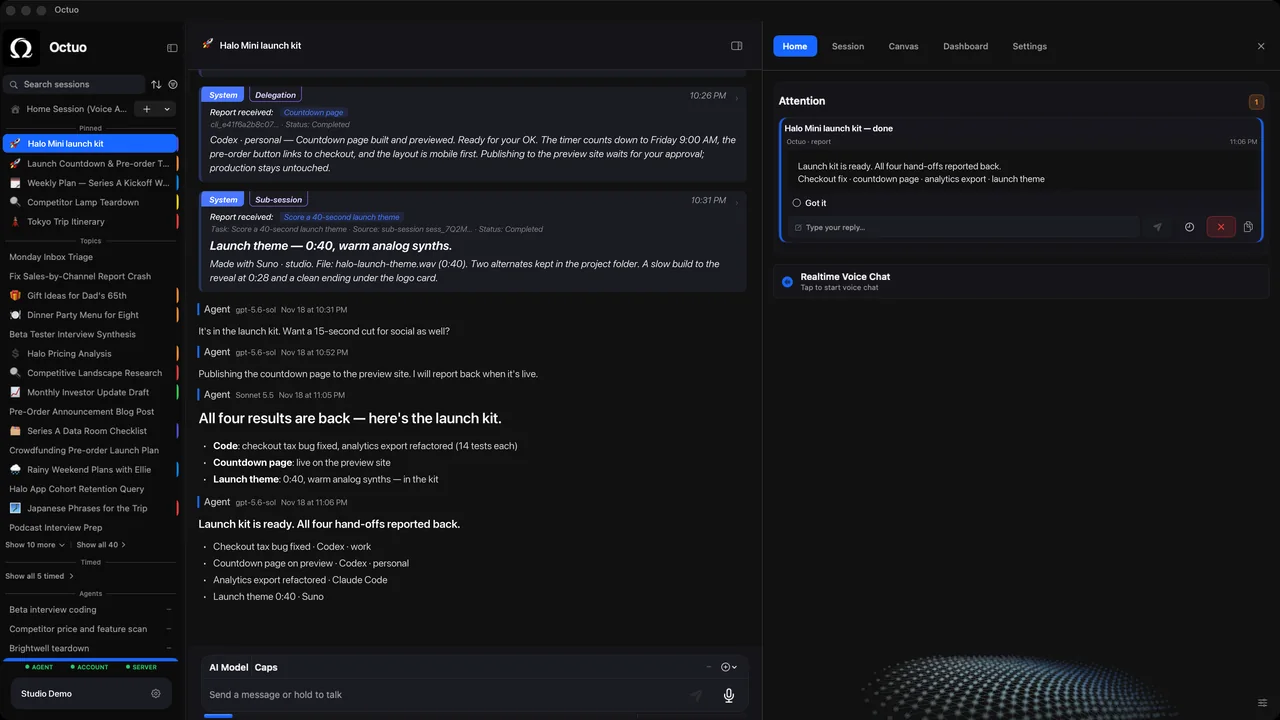
Octuo is a personal assistant and one starting point for work across AI, tools and specialist services. It keeps working on long, multi-step jobs over time, picks them back up and finishes them instead of stopping when the chat closes, and it reports back when a job is done, so a big batch can run while you do something else and be waiting for your sample when you return. Octuo is available for macOS.