How to hand off a research question: five parts of a good brief
मूल रूप से 2 अक्तूबर 2026 को WordPress पर प्रकाशित।
You ask someone, or something, to “look into” a topic and get back eleven pages of mostly true, mostly general material. Nothing in it is exactly wrong. It just doesn’t help you decide anything, and you can’t tell which parts you can lean on.
Research handed off in one vague sentence tends to come back as a survey. The cure is a brief with five parts, written before the work starts. It takes ten minutes, and it works the same whether the researcher is a colleague, a contractor or an AI assistant. The examples below are illustrative.
Part 1: The question and the decision it feeds
Write the question as a question, and add the decision it will feed. “What are the options for storing our signed contracts?” is a topic. “Which of these three options should we pick for storing signed contracts by the end of the month?” is a question with a use. The decision tells the researcher what to leave out, and that is most of the value.
Part 2: The scope
Say what is in and what is out: the time period, the region, the kind of source, the size of option you care about. A boundary written down saves hours. “Last two years only, English-language sources, options a team of ten could set up without an engineer” removes most of the internet before anyone starts reading.
Part 3: The source rules
Tell the researcher what counts as a source. Primary documents? Official pages? Independent reviews? Then say how to treat each kind: “Use official documentation for facts about features. Use independent writing for opinions only. Mark anything that rests on a single source.” Ask for a link or citation behind every claim you might repeat to someone else, so you can open it yourself.
Part 4: The shape of the answer
Decide what you want back before you ask. A comparison table of options against your criteria? A one-page recommendation with reasons? A list of open questions? If you will paste the result into a document, ask for it in that document’s shape. And put the answer first, so the first thing you read is the thing you need.
Part 5: What would change your mind
This is the part most briefs leave out. Add one or two lines: “If the cheapest option cannot export our data, drop it.” “If two sources disagree about a price, tell me rather than choosing.” It gives the researcher a tripwire, and it gives you a reason to be told early rather than late.
A hypothetical brief, in full
“Question: which of these three tools should we use to store signed contracts by the end of the month? Decision: choose one and start moving files next week. Scope: the last two years, English-language sources, options a team of ten can set up without an engineer. Sources: official documentation for features, independent reviews for opinions only, and a link behind every claim. Shape: a table of the three options against four criteria, with a one-paragraph recommendation above it. Tripwire: if an option cannot export all our files in a standard format, drop it; if sources disagree, say so.”
Where Octuo fits
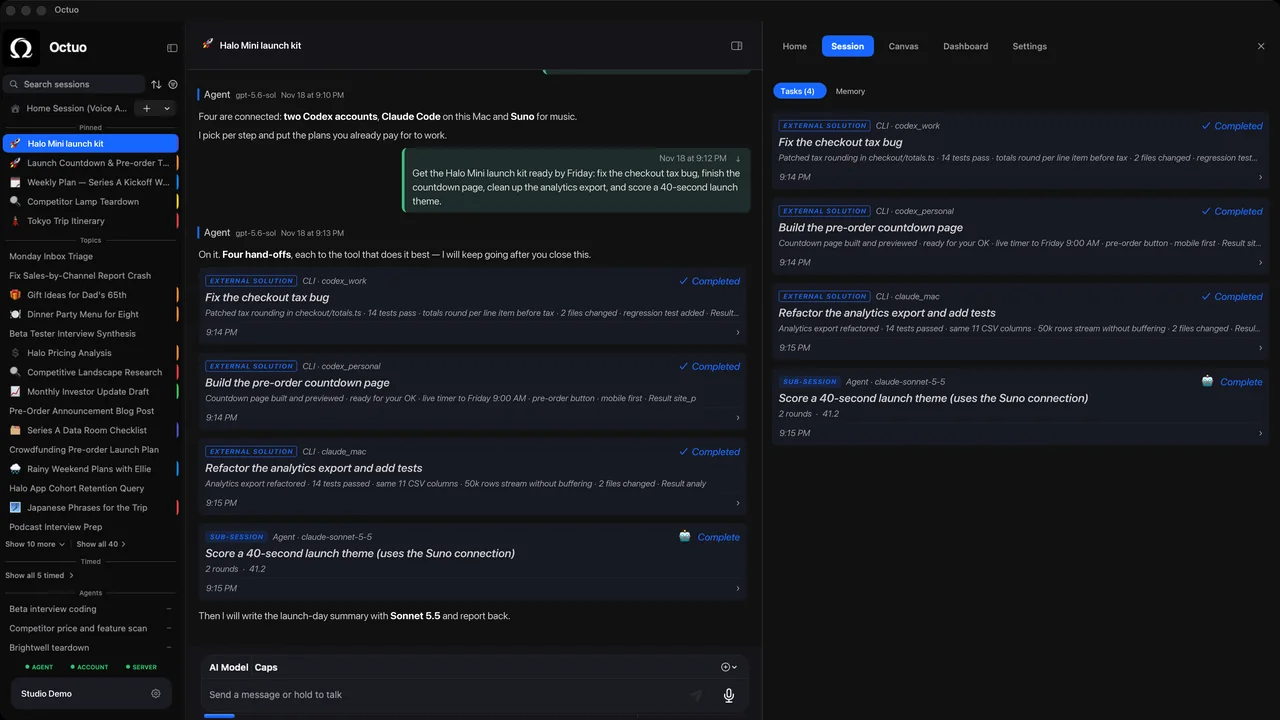
We’re the Octuo team. Octuo is a personal assistant and one starting point for work across AI, tools and specialist services. Research is a natural thing to delegate: Octuo hands tasks to outside services and to specialist tools you’ve installed, set up and authorized, it can control the browser and perceive your screen under your control, and it gives you access to many models from different providers, with the choice of which to use for what left to you. It reports back when a job is done. Octuo is available for macOS.