Is skipping Claude Code or Codex prompts safe?
No setting makes it safe, and neither vendor's docs promise it does. Both tools have two separate dials: whether the agent asks first, and what it can reach once it runs. Fewer questions can be a reasonable choice when that second dial is tight, the work can be undone and you review the result.
What does "without asking" actually switch off?
Only the prompt. Claude Code's docs say a permission mode "sets which actions Claude can take in a session without asking you first." Codex splits the idea in two: a sandbox mode (what Codex can do technically) and an approval policy (when it must ask). The dials move independently: Codex's docs describe a run that never asks yet stays inside a read-only boundary. So ask two questions: what may it do without asking, and what can it touch when it does?
What do the two tools document?
Claude Code. In Manual mode it asks before most actions that edit files, run shell commands or reach the network. In auto mode a second model reviews actions instead of you, and by default blocks things such as running downloaded code, sending sensitive data out, production deploys and force pushes. The docs add: "Auto mode reduces permission prompts but does not guarantee safety." The mode that skips the safety checks belongs only in isolated environments such as containers or VMs. On recent versions auto mode is the built-in starting mode in interactive terminal sessions, so check which mode you are in.
Codex. Locally, network access is off by default and an OS-enforced sandbox limits what it can touch, typically to the current workspace. The Auto preset lets it read, edit and run commands there, and asks before editing elsewhere or using the network. The docs label no sandbox plus no approvals "not recommended" and warn that prompt injection can make an agent fetch and follow untrusted instructions.
What does a sandbox not cover?
Claude Code's sandbox is off by default and wraps shell commands only; its file tools, local MCP servers and hooks run outside it. Sandboxed commands can still read most of the machine by default, including credential files such as ~/.ssh. The docs say plainly: "Sandboxing reduces risk but is not a complete isolation boundary."
In Claude Code, a rule typed in chat is not a guarantee either: a stated boundary can be lost when context compaction removes the message, and a deny rule is the way to a hard guarantee.
How can I loosen it more carefully?
These steps make mistakes easier to catch and undo. None makes a run safe.
- Start narrow, widen one notch at a time, only after clean runs; see earning trust in stages.
- Work on a branch and commit often. Codex's docs suggest a feature branch and a clean working tree before you delegate. Read the diff afterwards.
- Keep hard-to-undo steps behind your own yes: sending, deleting, publishing, paying. Choosing what to keep human has a filter for this.
Where Octuo fits
This page is about the settings inside Claude Code and Codex themselves, and nothing here is a safety promise from us.
Octuo is a personal assistant that coordinates your AI tools, agents and outside services for you: you say the goal, and it handles the preparation, delegation and follow-up. Coding agents such as Claude Code and Codex are examples of what it can hand work to (no partnership or endorsement), so read each tool's own settings first.
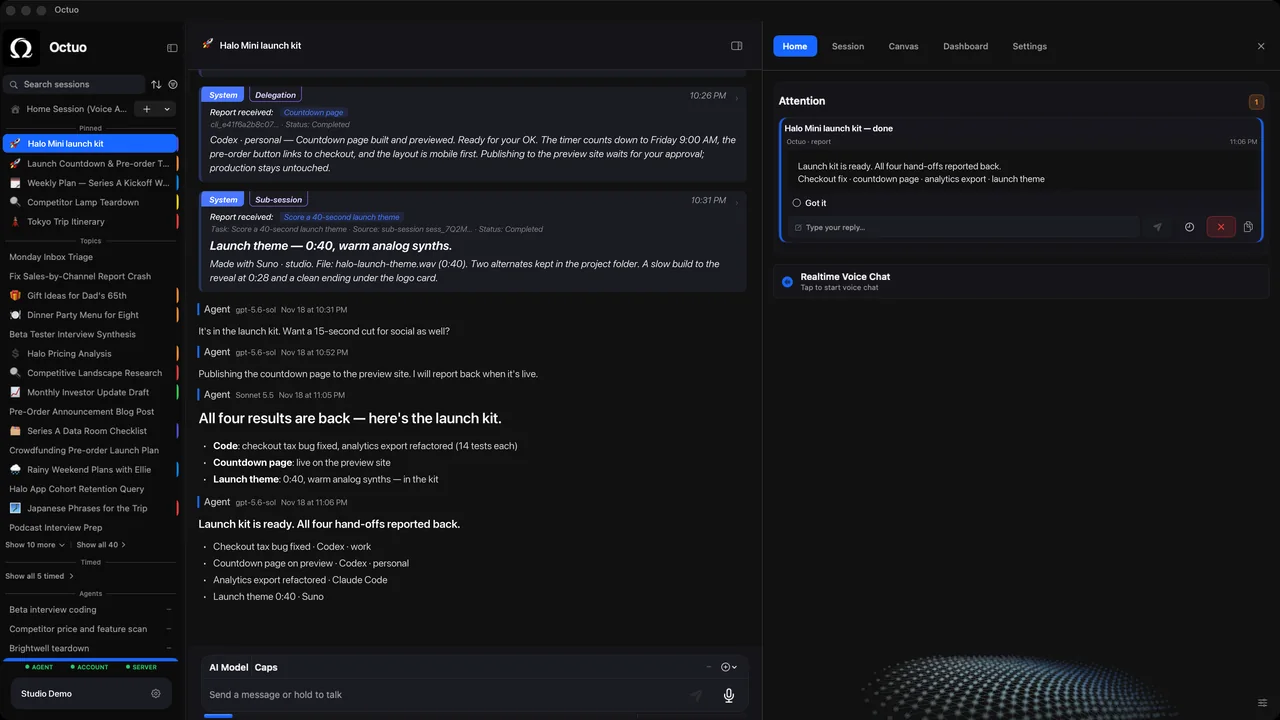
Decisions that need you come to Attention. You grant the permissions it works with. Credentials live in an encrypted Secrets Vault: the language model never sees raw credentials, and every use is written to an audit log. You step in for your own account sign-ins, payments and sensitive approvals that must be yours; Octuo handles the surrounding work. Octuo is a native Mac app. See what Octuo does.
FAQ
Is auto mode the same as skipping permissions? No. Auto mode still has a classifier reviewing actions; the skip-everything mode removes most prompts and checks and, per the docs, belongs in isolated environments.
Does a sandbox mean I can stop watching? No. Claude Code's docs call a sandbox a risk reducer, not a complete boundary. Keep reading the diffs.
What should never run without asking? Anything hard to undo: sending, deleting, publishing, paying, production. Let the tool prepare those steps; keep the final yes yours.
Sources
- Claude Code docs, "Choose a permission mode": https://code.claude.com/docs/en/permission-modes
- Claude Code docs, "Configure the sandboxed Bash tool": https://code.claude.com/docs/en/sandboxing
- Codex docs, "Agent approvals & security": https://learn.chatgpt.com/docs/agent-approvals-security
- Codex docs, "Sandbox": https://learn.chatgpt.com/docs/sandboxing
The product names above belong to their owners. We have no affiliation with them.